
can we please stop protein-ifying everything?
On the commodification of protein, dot cakes and food and community

A few weeks ago, I came across a recipe for a protein birthday cake.
YES, an ACTUAL birthday cake complete with frosting, candles, and decorations. The comments were filled with excitement. People celebrated the fact that it contained over twenty grams of protein per slice. Others praised it for being “guilt-free” and “healthier than normal cake.” As I scrolled through hundreds of comments discussing protein content, calories, and macros, I wondered why nobody was asking the obvious question: why does birthday cake need to be healthy in the first place?
This may sound like a strange complaint in an age where health and fitness are increasingly prioritised. After all, protein is essential. It helps repair tissues, build muscle, and supports countless functions within the human body. Despite the title of this article, I don’t hate protein. The issue is how protein has become the basis of any food eaten now.
. What was once simply one nutrient among many has become an identity, a marketing strategy, and a symbol of moral virtue. Today, food is increasingly judged not by its taste, cultural significance, or ability to bring people together, but by whether it contributes to a specific number of calories.
It is impossible to ignore how deeply this obsession has infiltrated modern food culture. Walk through a supermarket, and you’ll find protein chips beside regular chips, protein cookies beside regular cookies, protein ice cream beside regular ice cream, and protein cereal beside regular cereal. Foods that existed perfectly well on their own have suddenly been redesigned and repackaged around a single nutrient. Food companies have discovered that few words sell better than high-protein, and influencers have built entire careers around convincing people that every meal, snack, and dessert should somehow contribute to muscle growth.
Every day, millions of people consume content centred around “high-protein meal ideas,” “protein-packed desserts,” and “easy ways to hit your protein goals.” The message is relentless, food is merely fuel, snacks should be healthy, and eating should be productive.
What makes this particularly interesting is that the obsession extends far beyond foods traditionally associated with fitness. If protein culture were confined to chicken breasts and protein shakes, it would hardly be noteworthy. Instead, it has spread into foods that were never intended to serve a nutritional purpose beyond enjoyment. Desserts, especially, have become targets of this transformation. Brownies become protein brownies. Cookies become protein cookies. Ice cream becomes protein ice cream. Cheesecake becomes protein cheesecake. Even coffee is no longer safe. We have reached a point where people are adding protein powder to beverages that already serve an entirely different purpose. (Yes, protein powder makes me want to rip my hair out)
The dot cake trend shows this well. When dot cakes first became popular online, they were fun and merely a sprinkle smorgasbord. It didn’t take long before the massive trend reached the fitness influencers. What had started as harmless fun became another opportunity to increase protein intake. Protein vanilla cake mix, protein frosting, “healthy” sprinkles. Never mind the fact that cake was never supposed to be healthy, never mind the fact that it probably tastes disgusting, IT JUST HAS TO HAVE PROTEIN.
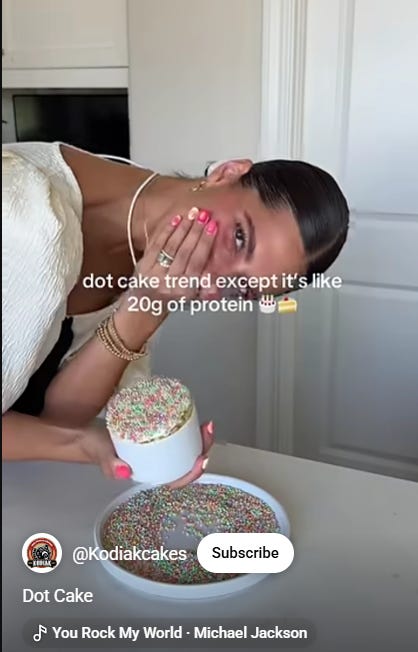
It is no longer enough for food to create joy. It now has to justify its existence through measurable nutritional value.
We live in a society obsessed with optimisation. Hobbies become side hustles. Reading becomes self-development. Sleep becomes recovery. Walking becomes exercise tracking. Every aspect of life is expected to produce something good for you. Food has simply become another casualty of this mindset. We are increasingly uncomfortable with activities that exist solely for pleasure, and eating is no exception.
The consequences of this mentality become particularly visible when we look at social media food culture. One observation that frequently appears online is how identical everyone’s meals seem to have become. A post by julia recently showed that every “What I Eat In A Day” video follows the same script: smoothie bowls, avocado toast, Greek yoghurt, protein shakes, chicken bowls, and protein bars. Where are the people eating leftovers from their grandmother’s house for a week because she insisted they take food home? Where are the family recipes? Where are the cultural dishes? Where are the meals that actually tell us something about people’s lives? ( yes my convo with julia inspired this article, thank you queen)
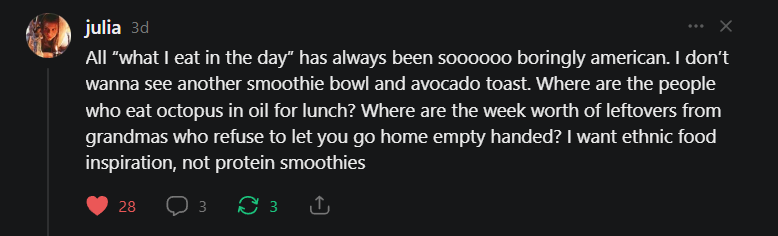
Food content has become increasingly detached from culture. Historically, food served as one of humanity’s strongest expressions of identity. Recipes reflected geography, history, migration patterns, religion, and family traditions. Food told stories. A family biryani recipe carried generations of knowledge. A bowl of soup might reflect centuries of cultural history. A dessert could symbolise a religious holiday or family celebration. Meals connected people to their communities and ancestors in ways that extended far beyond nutrition.This is especially present in South Asian culture, where it is often joked that our outings and gatherings exist solely around food.
Yet modern food content often strips away these stories. Instead of showcasing cultural diversity, algorithms reward the same old boring standardisation. The same handful of wellness-approved foods appear repeatedly regardless of where the creator lives or what cultural background they come from. Someone living in Karachi may post meals that look remarkably similar to someone living in Los Angeles. Protein oats. Protein smoothies. Protein bowls.Chicken bowls. Yoghurt bowls. The unique traditions that once made food fascinating are gradually being replaced by meals primed for engagement and nutritional branding. ( also im very pissed off that everything has to be in a “bowl”. Do you all not use plates anymore, because why is everything so perfectly arranged in a bowl and not mixed up on a plate)
This shift becomes even more significant when viewed alongside the decline of communal eating. For most of human history, food was fundamentally social. Anthropologists often describe communal meals as one of the foundations of civilisation itself. Across cultures and throughout history, people gathered around food to celebrate births, mark religious occasions, resolve conflicts, and strengthen relationships. Eating together was never simply about consuming calories. It was about creating bonds.
In many parts of the world, especially across South Asia, food remains one of the primary ways families express love and connection. Grandmothers prepare enormous amounts of food despite knowing only a few people will be coming over. Parents insist guests eat more, even after they have clearly had enough. Family gatherings revolve around shared dishes placed in the centre of the table. Holidays such as Eid are remembered as much for the meals shared with loved ones as for the celebrations themselves. These traditions are not merely about food. They are about belonging.
Food culture is moving away from this communal model and toward an individual one. Meal-prep culture offers a striking example. Social media is filled with videos showing rows of identical containers neatly arranged inside refrigerators. Breakfast for one. Lunch for one. Dinner for one. Entire weeks are planned, measured, and portioned in advance. While meal prepping can certainly be practical, it also shows a change in how we think about food. The focus is no longer on gathering around a shared meal. It is on managing personal nutritional goals as efficiently as possible.
There is something profoundly different about a meal prepared for a family and a meal prepared for a spreadsheet. One is about connection. The other is about efficiency. One creates memories. The other creates a lean body. Neither is inherently wrong, but the growing dominance of the latter reveals what modern society increasingly values. I could go into how this change also perpetuates harmful body standards and eating disorders, but let’s save that for another article.
Ironically, research suggests that one of the healthiest eating habits has very little to do with protein content. Studies consistently show that regular family meals are associated with stronger emotional bonds, better communication, improved mental health, and healthier long-term eating habits. Children who regularly eat with their families often report feeling more connected and supported. The benefits come from the experience itself. They emerge from conversation, laughter, storytelling, and shared routines.
There is no nutrition label for those things.
No protein target can measure the comfort of eating a family recipe passed down through generations. No calorie tracker can quantify the joy of sharing birthday cake with friends. No wellness influencer can calculate the value of sitting around a crowded table while relatives argue, laugh, and tell stories late into the night.
This is not an argument against protein. Protein matters. Health matters. Nutrition matters. The problem begins when food is reduced to nothing but nutrition. When every meal becomes a self-improvement project. When every cultural tradition is evaluated according to its macro profile. When food loses its social, emotional, and cultural dimensions.
The real question is why we have become so uncomfortable with food that serves no productive purpose. Why are we unable to let cake be cake? Why does a brownie need to contribute to muscle growth? Why must every food trend eventually become a wellness trend?
The moment food becomes nothing more than fuel, we lose something much larger than dessert.
We lose the stories attached to recipes. We lose the traditions passed down for generations. We lose the family dinners that stretch late into the evening. We lose the joy of eating simply because something tastes good. Most importantly, we lose one of humanity’s oldest ways of connecting.
Food is community, it’s the scent of your grandma’s cooking, the laughter while eating on the ground together, it’s the midnight snacks with your cousins, the baking with your sisters and eating the batter straight out of the pan. Food is meant to be shared, meant to be shared in a community; it’s not just the fuel you need for your body, it’s fuel for the soul
“Maybe the healthiest thing about food was never the protein content, but the people we shared it with.” ❤️🍰🍽️
This was a very powerful article and I agree why does a cake need to be healthy? Like okay don’t have it every day but once in a while it’s ok to indulge a little and enjoy yourself .